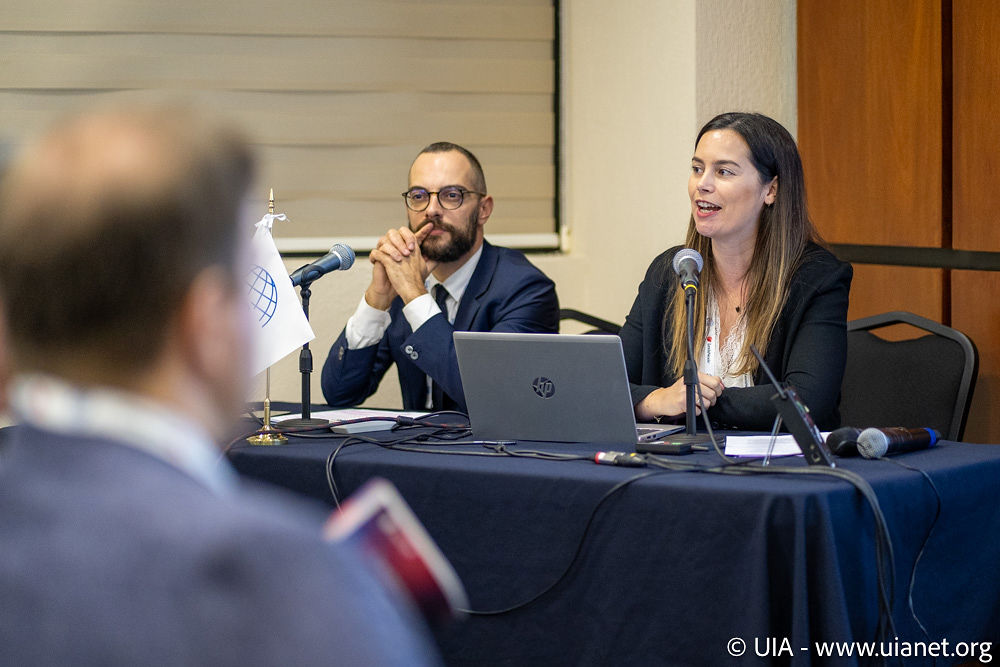
(UIA Congress – Guadalajara, Mexico)
At the 69th Congress of the International Association of Lawyers (UIA) in Guadalajara, Anna Klein spoke during the panel dedicated to Intellectual Property and Fashion Law entitled “Tradition Meets Innovation: IP Tools for Safeguarding Heritage and Excellence, with a Special Focus on the Fashion Industry.”
Her contribution was built around a central idea: in the fashion and craft industries, value does not rely solely on novelty. While intellectual property law traditionally protects innovation – original works, new designs, distinctive trademarks – many businesses derive their competitive advantage from different elements: origin, authenticity, know-how, and inherited quality standards.
In this context, an effective intellectual property strategy must go beyond traditional IP tools and incorporate mechanisms specifically designed to safeguard heritage and territorial excellence.
Geographical Indications for Craft and Industrial Products: A Major Development
A key focus of the discussion was EU Regulation 2023/2411 on Geographical Indications (GIs) for craft and industrial products.
Until recently, the EU GI system mainly applied to agricultural and food products. The new framework now extends protection to sectors such as textiles, jewelry, lace, leather, ceramics, stonework, woodworking, and other forms of craftsmanship that are integral to the fashion ecosystem.
This development is particularly significant for the fashion industry. It enables the protection of products whose reputation stems from their territorial roots: a combination of natural factors, local techniques, and traditional know-how. Unlike traditional IP rights, a GI does not grant an exclusive monopoly. Several producers may use the protected name, provided that they comply with detailed product specifications.
The objective is not to eliminate competition but to regulate it, prevent free-riding, and ensure authenticity and compliance with established standards.
Full application of the new regime is scheduled for 1 December 2025. Existing national craft and industrial GIs will need to be converted at EU level before December 2026. This reform represents a major step forward in the legal recognition of European artisanal heritage.
The “Savon de Marseille” Example: When GI Protection Is Not Available
Anna Klein also addressed the well-known example of “Savon de Marseille.”
Despite its reputation, attempts to obtain GI protection encountered significant obstacles, particularly due to the difficulty of demonstrating a sufficiently strong link between the product’s characteristics and a clearly defined territory.
As a result, stakeholders turned to a collective figurative trademark supported by detailed specifications. This solution protects a specific logo reserved for producers who comply with agreed standards. However, in the absence of GI protection, the term “Savon de Marseille” itself remains available for use.
This example highlights an important strategic reality: when origin is the core asset, combining different IP tools – GIs, collective marks, or certification marks – may be necessary.
“Made in” Claims: Powerful Marketing, Strict Legal Requirements
The panel also explored the sensitive issue of “Made in” claims in the fashion industry.
Statements such as “Made in France” strongly influence consumer perception, often associating products with quality, ethics, and sustainability. However, these claims are subject to precise legal rules.
Under EU law, origin generally corresponds to the place of the last substantial transformation. Consequently, a product may qualify as “Made in France” even if certain manufacturing stages or raw materials originate elsewhere. This legal reality may not always align with consumer expectations.
Stricter voluntary labels, such as “Origine France Garantie,” impose higher national value-added thresholds. In addition, consumer protection law strictly prohibits misleading commercial practices relating to origin or product characteristics.
In an increasingly international market, origin-based branding strategies must therefore be legally robust and fully aligned with the actual production process.
Conclusion
Anna Klein’s intervention at the UIA Congress demonstrates that intellectual property is not limited to protecting technological or creative innovation. It also serves as a strategic instrument to preserve heritage, regulate the use of origin, and enhance traditional know-how.
For fashion, luxury, and craft businesses operating internationally, developing an IP strategy aligned with the territorial dimension of their value proposition has become a key factor for competitiveness and legal compliance.